The Idea Catalog platform has had plenty of upgrades in 2025.
Problem Definition
Problem definition is crucial because it shapes everything that follows. Here's why it matters:
It prevents solving the wrong problem. You might spend months building something nobody needs, or fixing a symptom while the root cause persists. A clear problem definition ensures you're addressing what actually matters.
It aligns people. When stakeholders, teams, and users share a common understanding of the problem, they can collaborate effectively instead of working at cross-purposes or duplicating effort.
It guides better solutions. A well-defined problem reveals constraints, success criteria, and trade-offs upfront. This helps you evaluate options objectively rather than getting attached to a particular solution too early.
It saves resources. Clarity about the problem helps you scope work appropriately, prioritize features, and avoid scope creep. You're less likely to waste time and money on unnecessary complexity.
It creates a basis for measurement. When you know exactly what problem you're solving, you can define what success looks like and actually measure whether your solution works.
Without proper problem definition, you're essentially wandering in the dark - you might get lucky, but you're far more likely to end up somewhere you didn't intend to be, having spent far more than you needed to get there.
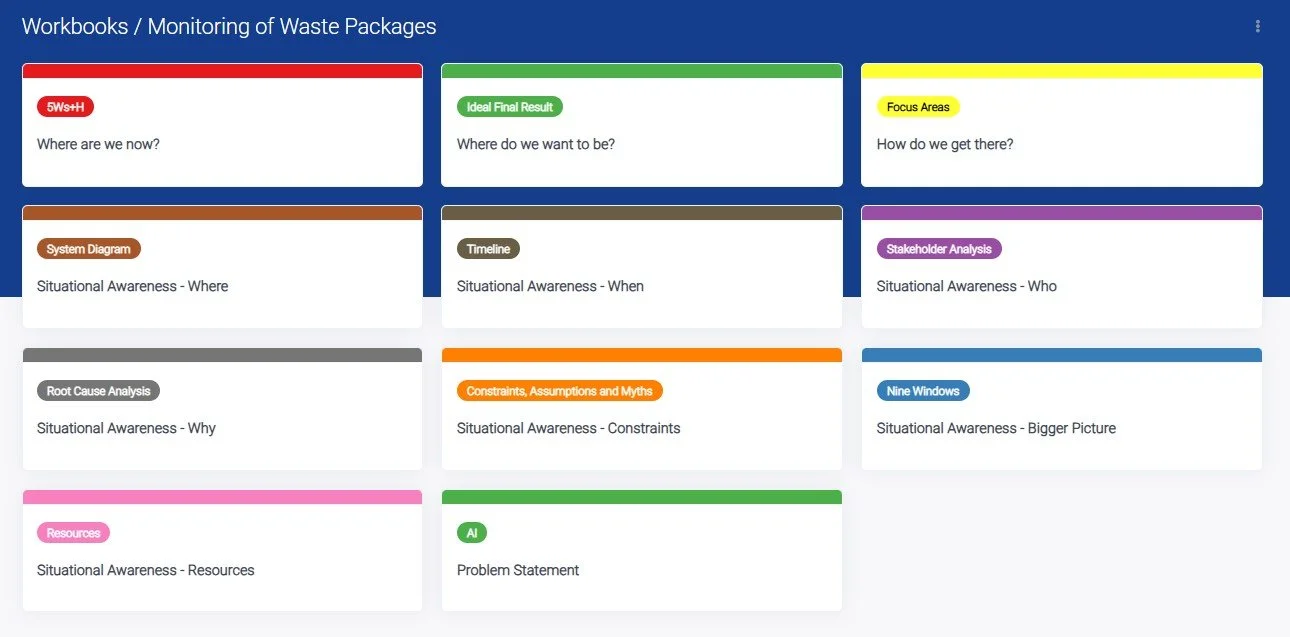
We now have 11 tools available for problem definition each of which provides a piece of the puzzle. You don’t need to use them all of course as it depends on the complexity and context of your specific problem, but #1 is always worth using for pretty much all problems:
5Ws+H. Where are we now?
Ideal Final Result. Where do we want to be?
Focus Areas. How do we get there?
Situation Awareness - System Diagram. Where is the problem?
Situation Awareness - Timeline. When does the problem occur or when did it happen?
Situation Awareness - Stakeholder Analysis. Who is involved?
Situation Awareness - Root Cause Analysis. Why did the problem happen?
Situation Awareness - Constraints, Assumptions and Myths. What is stopping us from fixing the problem?
Situation Awareness - Nine Windows. What can we see from looking in multiple dimensions - time and space?
Situation Awareness - Resource Analysis. What resources do we already have that might solve the problem?
Problem Statement. Summarizes all the above into a neat actionable page. Excitingly, the Problem Statement uses our band new AI agent to help summarize the content. It will save a huge amount of time.
You use the first three tools to generate a comprehensive, shared understanding of the problem. Then the others are used, as necessary, to drill down in more depth. Finally you use #11 to bring everything togther.
Ideas Bank
These are Boards (like you have in Pinterest) where you save catalog entries that are relevant and interesting for you. These can be shared with Team members to provide a collaborative space for collecting ideas. These form the basis of your Long List and Short List of potential solutions for your problem and are used for documenting that evidence base and to show you have looked at a wide range of technologies from different industries and countries.
Flipcharts
We’ve had flipcharts for several years to use like paper versions; write notes and draw diagrams. Like the Ideas Bank boards, these are sharable for collaborative use within a team. Each year we add more functionality and in 2025 we added more line types (dotted and thick and more colors)) and more shapes to help differentiate items in diagrams. It’s a powerful tool, comparable to many others that require additional cost, and is already included in our platform.
Premium Features
Although the free version provides many features, the paid-for Premium version unlocks the platform’s full capabilities. Please contact us for a quotation. Additional features introduced in 2025 include:
Filtering in Insights, Library and Video tabs. You can narrow down selections within individual tabs of an entry that is particularly useful for those with lots of documents or videos.
We have enhanced the search capability considerably with an improved user interface for ElasticSearch (as used by FaceBook, Wikipedia and Walgreens plus many others) and we have enhanced the algorithms relevance tuning, synonyms and curations to make the search experience even better.
If you would like more information on the platform or perhaps to discuss a workshop for a specific problem please don’t hesitate to get in touch. iseed@cogentus.co.uk