Introduction: The High Cost of Solving the Wrong Problem
In high-stakes industrial sectors, specifically nuclear decommissioning, the most pervasive inefficiency is not a lack of technical capability, but a failure in the discovery process. Engineering teams frequently succumb to "wandering in the dark"; spending months of budget and labor developing bespoke solutions for problems that have already been solved, or fixing superficial symptoms while the true root cause remains unaddressed. This cognitive bias and duplication of effort across the global nuclear sector represent a significant drain on tightening budgets. The strategic reality is that approximately 99.7% of innovation is not the result of ground-up invention, but the application of known solutions to new contexts.
The challenge is architectural: standard information repositories organize data by how it was generated (e.g., by vendor or specific project). To optimize the technology selection pipeline, a discovery engine must instead organize information by how it is used. The Idea Catalog, established as "Pinterest for nuclear cleanup" contains up-to-date technologies and projects from all US nuclear sites plus those of the UK, Canada and elsewhere, has now integrated an AI-powered suite designed to automate this transition from unstructured "random" brainstorming to a systematic, defensible technology discovery process.
The Foundation: AI-Powered Problem Definition
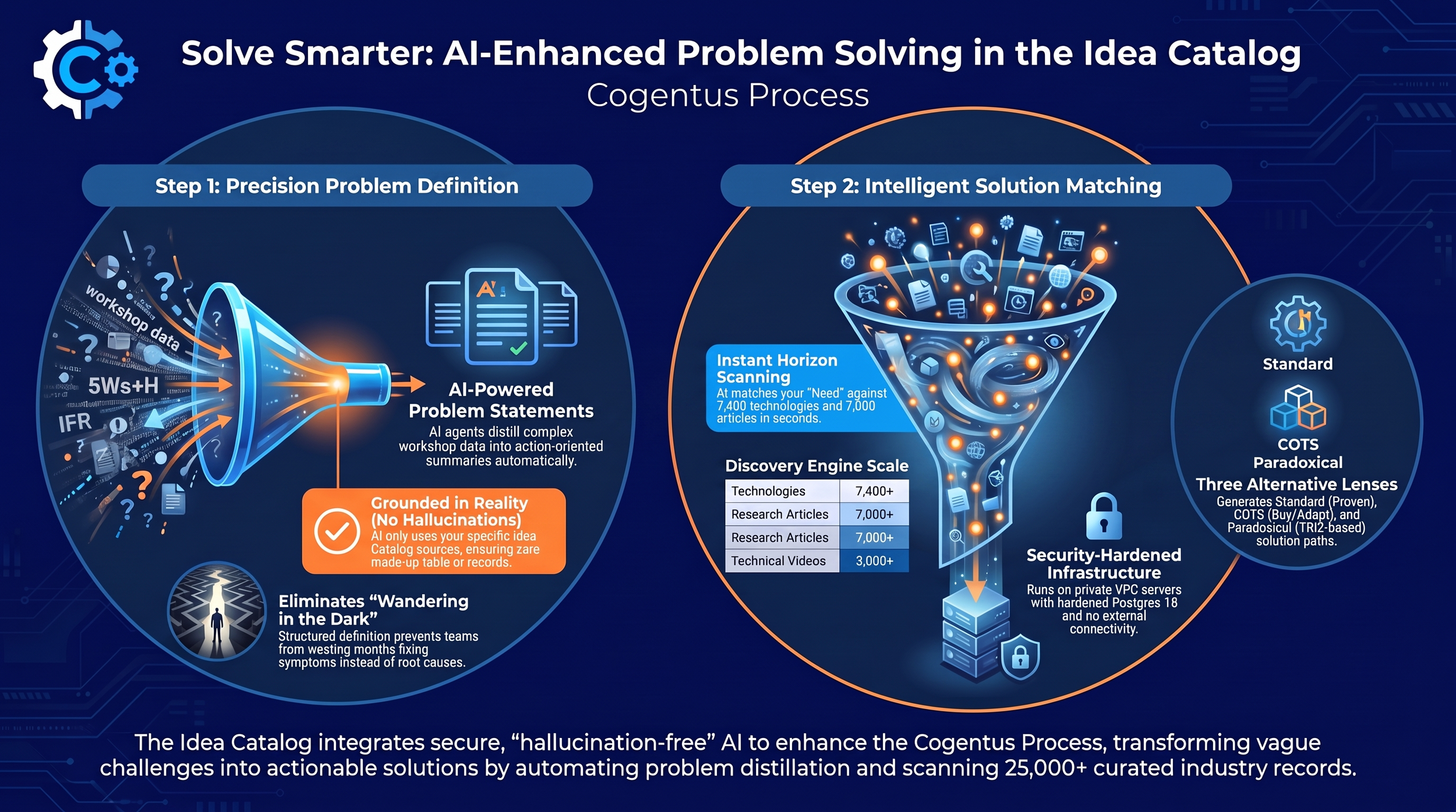
Within the process, the problem definition phase is the pivot point for defensibility. Rushing toward technology selection without a rigorous definition of the "Need" leads to project failures that are extremely costly in multi-decade decommissioning timelines. The Idea Catalog’s AI supports this phase through three primary frameworks:
The 5Ws+H: A structured investigation into who is impacted and where the problem occurs, utilizing a "Five Whys" root cause analysis to drill past surface-level engineering hurdles.
Ideal Final Result (IFR): A solution-free description of a perfect outcome that maximizes benefits while eliminating costs and harms. This ensures success is defined by the required outcome rather than the available hardware.
Focus Areas / Lines of Inquiries: The topic areas where solutions are needed; often sub-problems of the main overarching one.
“Getting your problem definition right isn’t just about process. It’s basically the only way to stop you from just wandering in the dark, maybe wasting months building something nobody actually needs or worse, just fixing symptoms instead of the real root cause.”
The AI agent synthesizes these complex workshop inputs into a single, action-oriented Problem Statement. This document serves as the "source of truth" to align stakeholders and provide the audit trail necessary to justify a chosen path.
The Exploration: AI-Powered Solution Finder
Lens 1: Standard Solutions (What Could I Try?)
Once the problem is defined, the AI applies the first of three evaluative lenses: Standard Solutions. This lens moves beyond the limited knowledge of the personnel in the room by leveraging 76 Standard Solutions derived from the TRIZ methodology of inventive patterns. By analyzing historically successful engineering patterns, the AI identifies proven strategies that have solved analogous technical needs in other industrial sectors. For a workshop, this provides a systematic method for improving existing systems using established patterns of invention rather than relying on the "hit-or-miss" nature of traditional ideation.
Lens 2: COTS Solutions (What Could I Buy?)
The second lens addresses Commercial Off-The-Shelf (COTS) technologies. This is the primary mechanism for mitigating the risk of redundant R&D. The AI matching engine scans the Catalog’s repository of over 20,000 assets to identify existing technologies that can be adopted or adapted. By identifying technologies already developed (or being developed) in the nuclear industry on other sites or in other countries (or in other industries), organizations can drastically reduce their time-to-deployment. This systematic horizon scanning ensures that "reinventing the wheel" is no longer a default operational mode, allowing teams to allocate limited resources only to those challenges that truly require bespoke development.
Lens 3: Wicked Solutions (Solving problems with contradictions)
For "wicked" problems where a standard approach feels impossible, the AI employs Lens 3. These challenges often involve a contradiction; a situation where improving one characteristic (such as speed or shielding) directly worsens another (such as weight or cost). Traditional engineering often settles for a sub-optimal trade-off. In contrast, the AI utilizes 40 universal problem-solving strategies to identify ways to resolve the conflict entirely. This lens is essential for breaking through cognitive blocks and mental walls, offering a pathway to resolve structural contradictions that standard brainstorming workshops rarely address.
The "No Hallucination" Guarantee: Grounded in Truth
In the nuclear sector, the "hallucination" risk inherent in general-purpose AI is a non-starter. The Idea Catalog’s AI is strictly grounded in a curated, peer-reviewed "evidence-base." It does not scrape the public internet; it operates exclusively on verified records moderated by experienced nuclear professionals. Technically, the system is designed for high-security environments with infrastructure that runs on security-hardened Postgres 18 servers and private VPC access with no external connectivity and private IP addresses.
All outputs are verified against a taxonomy of over 20,000 records, including 7,400 technologies, 7,000 articles, 5,000 documents and 3,000 videos. This architecture ensures that every technology suggestion is a real-world record, providing the auditable proof required by the organization, regulators and stakeholders.
Conclusion: From Days to Hours
The shift from manual, random brainstorming to an AI-powered discovery engine enables "Workshop Compression." Sessions that previously required several days of project time to define challenge statements and identify options are now distilled into cohesive, high-quality summaries in a fraction of the time. The strategic impact of this efficiency is three-fold:
Reduced Risk to Mission: Decisions are grounded in a global evidence-base of proven practices.
Defensibility: Organizations can demonstrate they have conducted a rigorous, independent review of global options, protecting their institutional reputation.
Capital Efficiency: By preventing the duplication of existing effort, budgets are focused on genuine innovation rather than redundant R&D. If nearly all innovation already exists somewhere in the world, the primary hurdle for nuclear decommissioning is no longer creativity, it is the adoption of a discovery engine capable of finding the light in the dark.
Why Support the Idea Catalog?
The NEA (WPTES) report “Innovative Techniques and Technologies to Support Characterisation and Decommissioning of Complex and Legacy Sites - WPTES Workshop Proceedings”, published 23 February 2026 noted:
“It is difficult for one organisation to develop, populate, validate and maintain a database of
current innovative technologies. The international community needs to work together to
publicise the existence of the database(s) and encourage everyone to contribute. Ideally,
the industry should select one individual to publicise information based on ease of access,
breadth of current content, and the ability of a host organisation to maintain the database.
Other similar databases should either be linked or the content should be transferred across
and the database abandoned."
We believe the Idea Catalog directly aligns with this comment in several practical ways:
Solving the maintenance and validation bottleneck: The WPTES correctly notes how difficult it is for any single organization to keep a technology database current. The Idea Catalog addresses this by utilizing a funded subscription model. This funding is dedicated entirely to the continuous research, daily updates, and codification of new public technologies, case studies, and documents. Funding is not tied to any one organization and since it is not dependent on a single funder it means that budget cuts will not mean the platform ceases to exist. Crucially, to ensure validation, all content is moderated by experienced nuclear professionals, shifting the heavy administrative and verification burden away from inexperienced individuals or project teams.
Encouraging crowdsourced community contributions: To foster the "work together" spirit mentioned, the platform provides built-in engagement tools. Through the "Suggest" capability, users, vendors, and practitioners can submit new technologies, practical experiences, and real-world case studies. These contributions undergo independent review before being codified, allowing the global community to actively shape the resource.
Consolidating and linking disparate databases: Instead of forcing teams to jump between isolated, fragmented databases, the Idea Catalog acts as a consolidated portal. It integrates diverse databases (including Decontamination, Robotics & Remote Handling, Characterization and Waste Treatment, Processing & Disposal) under a single, functional taxonomy. Rather than sorting databases by how the information was generated or who funded it, the platform is structured around how you need to use the information.
Acting as an Independent, unbiased host: The WPTES suggests the industry needs a neutral coordinator. The Idea Catalog is maintained by Cogentus as an unbiased platform independent of vendor or manufacturer influence. There is no advertising, and vendors cannot pay to promote their systems; their visibility is driven purely by the quality of their verifiable case studies and technical documentation. This neutrality ensures the database remains a trusted "knowledge asset" for the entire community.
Improving ease of access with grounded AI: To address the "ease of access" requirement, the platform has introduced a highly secure, private AI engine. Running locally with no external connectivity to protect sensitive project data, this AI matches complex, unstructured problem statements to the catalog's 25,000+ assets instantly. It makes the massive breadth of international content immediately searchable, allowing teams to find non-obvious technology matches in seconds rather than days.
Bottom Line Up Front
By centralizing the maintenance, providing a clear mechanism for global contributions, consolidating multiple technical domains, and offering independent hosting, the platform functions exactly as the collaborative, consolidated industry resource described by the WPTES report.
Access the platform at www.ideacatalog.net