In complex, highly regulated sectors like nuclear decommissioning and waste management, the most expensive mistake a team can make is rushing to a solution before fully understanding the underlying problem. Too often, project teams wander in the dark, spending months building bespoke systems to treat superficial symptoms rather than addressing the actual root cause.
To solve this, we are thrilled to announce the latest major upgrade to the Idea Catalog: a private, domain-grounded Artificial Intelligence (AI) engine designed to supercharge your Problem Definition and Solution Space Generation. Available now for Premium Plan subscribers, this update serves as a high-speed collaborator to help you define challenges, break through cognitive biases, and discover global technologies in seconds.
Here is a closer look at what has been added, how it works, and how it will transform your team's optioneering workflow.
Built on Uncompromising Security
We know that data privacy and system integrity are paramount in high-consequence industries. Unlike general-purpose public AI tools that leak data to the web, our AI engine is built on uncompromising security:
Locally Hosted Architecture: The AI runs entirely on security-hardened Postgres 18 servers.
Total Isolation: The infrastructure operates with private IP addresses, no external internet connectivity, and customer-managed disk encryption on the database itself.
Strict Source Grounding: The AI only references the curated data within the Idea Catalog. This ensures zero "hallucinations" and no made-up facts. Every suggestion is a real, traceable record grounded in physical reality
AI-Supported Problem Definition: Moving Past the Symptoms
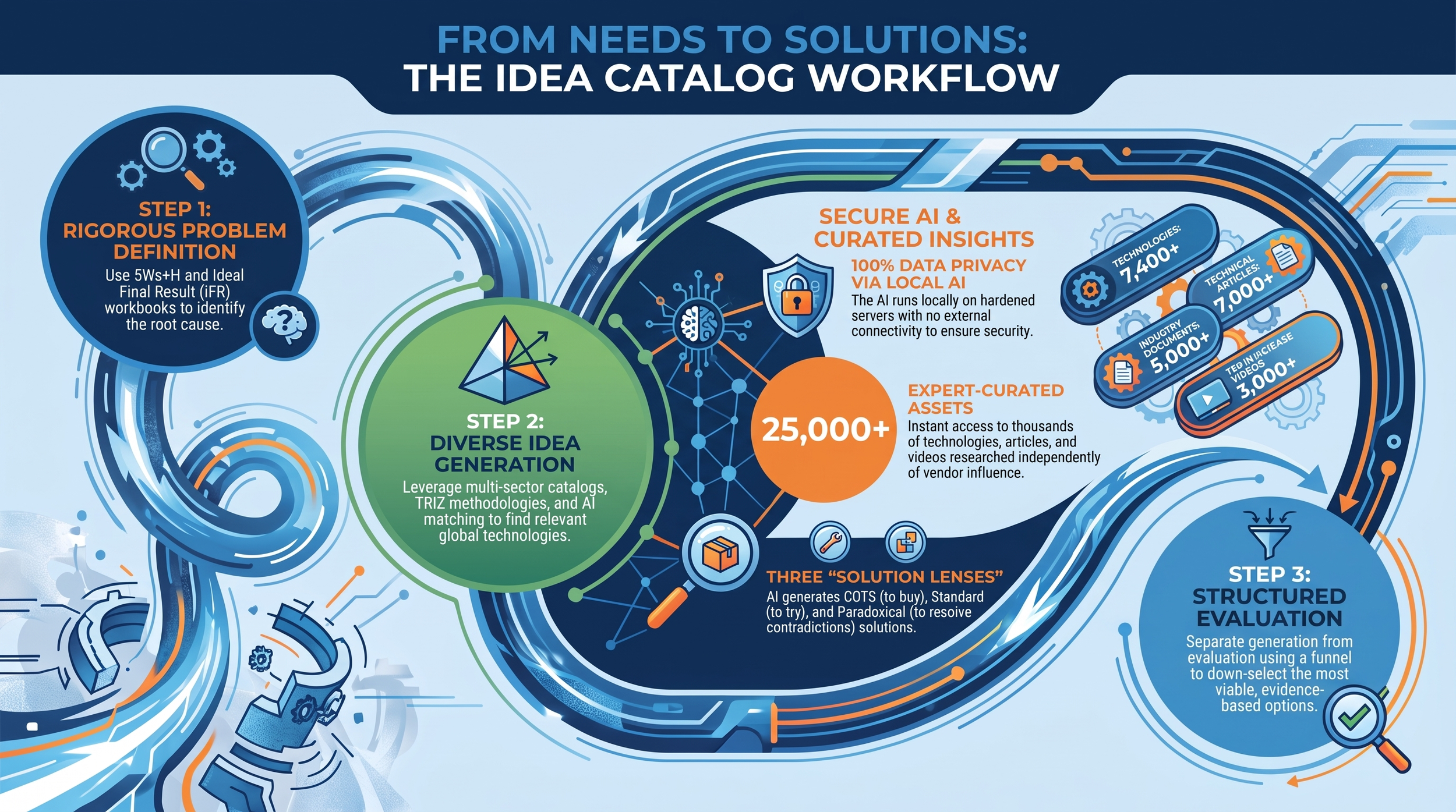
Getting your problem definition right is the absolute foundation of successful innovation. The Idea Catalog now uses AI to automate this crucial phase using structured, industry-standard methodologies:
The Investigation (5Ws+H): Users define what the problem is, who is impacted, when/where it occurs, and—most importantly—drill down into the why using the "Five Whys" technique.
The Destination (Ideal Final Result - IFR): Teams outline what a solution-free, perfect outcome looks like—maximizing benefits while minimizing costs and harms.
The AI Synthesis: Instead of spending hours compiling workshop notes, simply click "Generate problem statement with AI". The system instantly synthesizes your 5Ws+H and IFR inputs into a clear, action-oriented Problem Statement that gets all stakeholders on the same page.
The Solution Space: Three Alternating Lenses
Once your problem is clearly defined, the AI-driven matching engine steps in. It takes your Problem Statement and scans through the Idea Catalog’s vast database of over 25,000 curated records—including 7,400 technologies, 7,000 articles, 5,000 documents, and 3,000 videos—to instantly identify matching concepts.
To help you look at the problem from different angles, the AI maps potential solutions into three distinct categories:
COTS Solutions ("What could I buy?"): Commercial off-the-shelf technologies that already exist, helping you find systems that can be easily procured, adapted, or modified to avoid reinventing the wheel.
Standard Solutions ("What could I try?"): Proven technical strategies drawn directly from the 76 standard TRIZ inventive principles.
Paradoxical Solutions ("How do I solve a contradiction?"): Advanced suggestions using TRIZ Technical and Physical Contradiction methodologies to help you bypass traditional engineering trade-offs.
How to Get the Best Results: Quick vs. Better Methods
The platform is designed to be flexible depending on your time constraints:
The Quickest Method: On your workbook's "Problem Statement" card, type in your high-level Need, navigate to the "Solution Space" card, select "COTS Solutions," and hit generate. It takes only a minute or two to deliver a list of potential leads.
The Better Method (Avoid "Garbage In, Garbage Out"): A short, one-paragraph problem statement won't yield the deepest results. By spending extra time detailing the 5Ws+H, IFR, and Focus Area prompt cards before clicking the AI generation button, you supply the AI with rich, highly-specific context. This extra structure results in dramatically superior, context-aware technology matches.
AI Suggestions as "Stepping Stones"
We do not expect the AI to provide a "perfect," ready-made answer to highly complex, bespoke engineering problems. Instead, think of the AI-generated matches as stepping stones.
Review the AI’s suggestions, read the "Why it is relevant" notes, and let them spark new ideas. From there, you can perform manual, targeted searches, filter categories, and save your findings directly into your team's Ideas Bank to build out an auditable, peer-reviewed optioneering report.
Transform Your Optioneering Today
By compressing the time required for traditional optioneering workshops, the secure AI upgrade saves significant time and money while offering fresh, cross-sector perspectives to help your team break through mental blocks.
This feature is now live for all Premium Plan subscribers! Head to the Problem Definition tab to create your first workbook and experience the future of nuclear optioneering.
To learn more about upgrading your subscription or scheduling an expert-led optioneering workshop, contact our team at iseed@cogentus.co.uk or pjames@cogentus.co.uk, or visit us online at https://www.ideacatalog.net/.